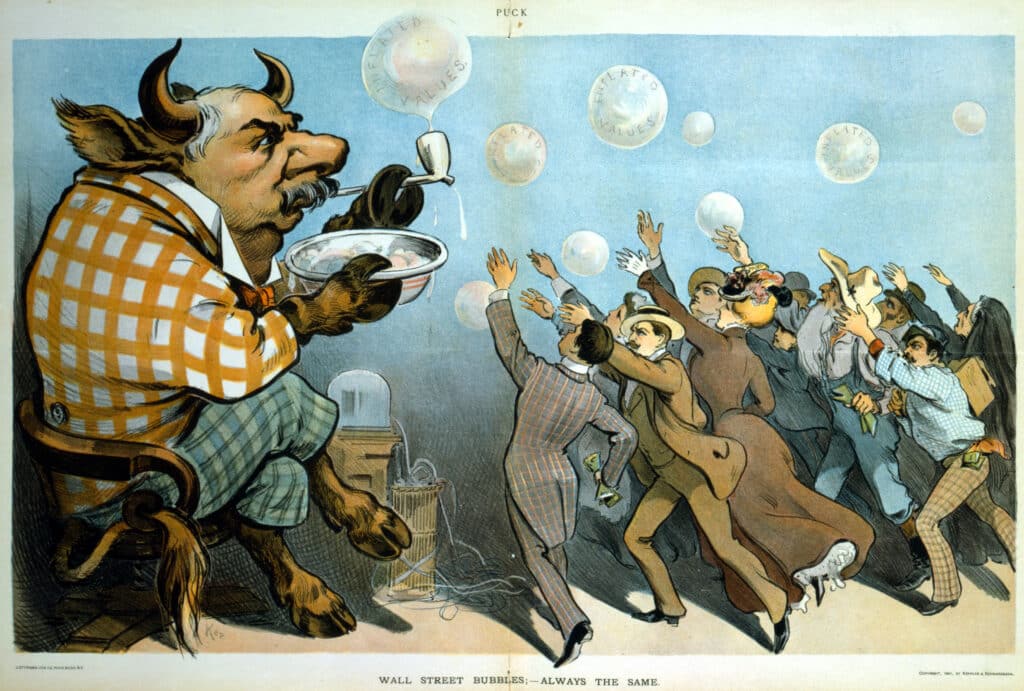
1901 Cartoon: “Wall Street bubbles – Always the same“
American financier J. P. Morgan is depicted as a bull, blowing soap bubbles for eager investors
What Will the “Corona Virus Correction” Reveal?
It’s only when the tide goes out that you learn who’s been swimming naked.
Hypothesis:
What if Corporate Profit Growth from 2014 to 2020 was “anemic“, rather than strong? What if many companies who had very little profit growth obscured this fact by borrowing in the bond market and using the proceeds to buy back their own stock. Their stock prices went up, not because they had greater earnings, but because they had reduced the total number of shares. In one dimension — earnings per share — these companies looked more attractive, but the borrowing corporations used to achieve this metric masked profit growth weakness and caused the companies’ credit ratings to decline, with many corporations falling to near “junk” status (BBB). On the Eve of the Coronavirus Correction, corporate debt was $10 Trillion, leaving many corporations vulnerable to an unexpected stress, and ensuring that once a “match was struck”, the dry “tinder” would burn quickly.
Now that the recession has begin, governments will be faced with reduced tax revenue and, as a result, will reduce their pensions’ purchases of bonds. Corporations have used money borrowed from these pension funds to buy back their own stock. Now that the pension systems have (indirectly) stopped lending them this money, corporations will have to reduce the amount of their stock buybacks. As stock buybacks decline, the ratio of sellers to buyers will rise and the price of these stocks will come under pressure.
It is too early to say where the bottom is to this recession, but we have reason to believe the Millennials and Generation X do not have the resources to purchase the stock that Baby Boomers want to sell at prior market highs. With Corporate profit growth unmasked and the Baby Boomer’s transition into retirement, it seems unlikely that stocks will make a quick return to their prior levels unless governments engage in massive asset inflation.
Here are my top 9 questions: #
- Is it true that Corporate Profits have been “Anemic” since 2014 and this has been obscured by “Financial Engineering”? 3 4
-
- Eric Basmajian writes on Seeking Alpha (Feb 28, 2020):
(click blue CiteIt.net arrows above and below quote to expand)Corporate America has been plagued by anemic economic growth in this economic cycle. Masked by the rising share price of roughly 500 companies, thousands of corporations that aren’t publicly traded have been forced to operate in a low-profit growth regime.
Financial engineering has allowed publicly-traded companies to report strong earnings growth. Total corporate profits reported in the GDP report is a far more accurate, albeit delayed, data source on the real (non-adjusted) profits generated by the corporate sector.
From 2014 through the start of 2018, corporate profits declined. The one-time spike in profits after 2018 was due to the corporate tax cut. Essentially, without the corporate tax cut, the corporate sector has seen virtually no profit growth since 2014.
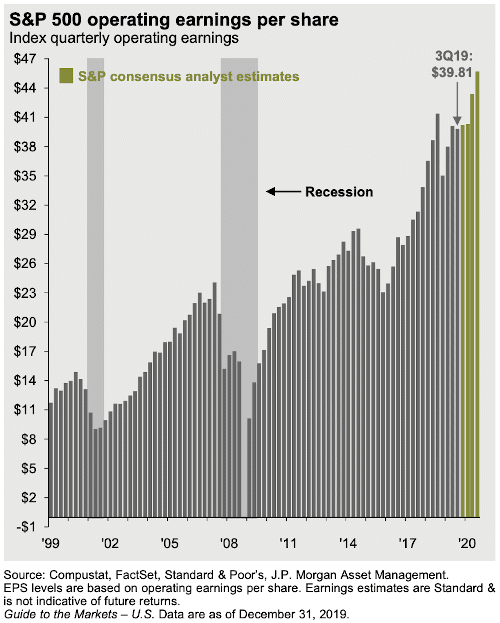
This assessment might seem “off” if you’re used to charts like this:
Chart 1: from JPMorgan (page 7):
- Eric Basmajian writes on Seeking Alpha (Feb 28, 2020):
But note that the S&P Earnings per share are heavily influenced by the share count reduction caused by buybacks.
- Here’s a different chart that features “total profits before taxes:“Chart 2: Corporate Profits Before Taxes: St Louis Federal Reserve
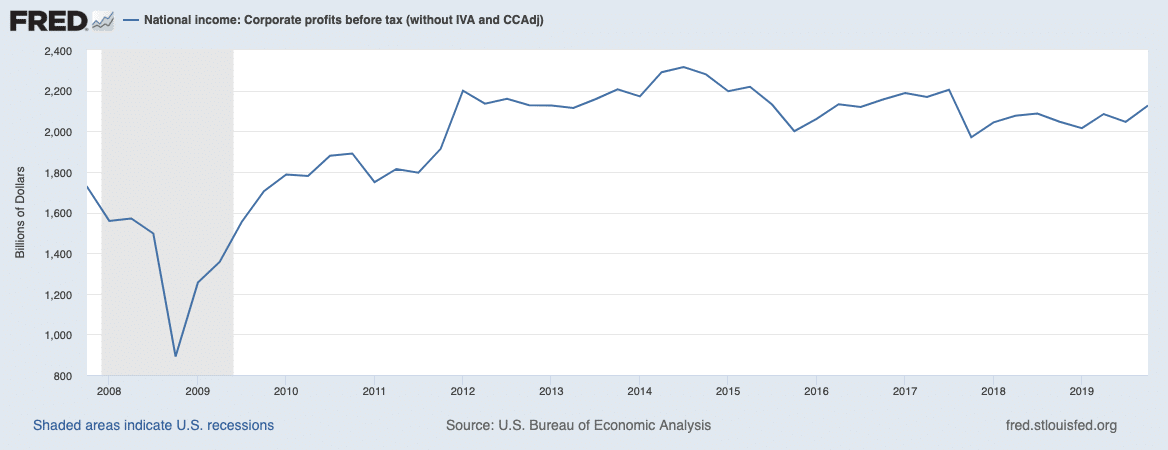
- Notice how flat profits have been since 2014 (actually it looks to me like they have been roughly flat since 2012).5
- Am I wrong to be concerned that companies appear to have engineered attractive EPS (Chart 2 – Earnings per Share from JPMorgan) by borrowing from the bond market (with funding from pension system) and weakening their credit ratings (many are rated just above “junk bond status”)?
-
Investors beware: Corporate profits are lower today than in 2014 : Marketwatch (Sept 26 2019)
-
Huge Disparity in Corporate Profits Hints at Something Amiss : Wall Street Journal (Dec 19, 2019)
-
- Is it true that Corporations have been the dominant buyer of their own stocks in 2018 and 2019?
New York Times columnist James B. Stewart cited Buffett’s quote from a 1992 letter to shareholders. Stewart describes leveraged loans as a potential problem areas to watch: (March 10, 2020)
↩Leveraged loans, which are private loans to already heavily indebted borrowers, could now emerge as the mortgage-backed securities and collateralized debt obligations of the financial crisis.
Warren Buffet repeated this “swimming naked” quote in his Feb 2008 letter to shareholders. ↩
I recognize there are other factors. Performance has been obscured largely by a combination of:
- Financial Engineering,
- Corporate Tax Cuts, and
- Loose Federal Reserve Monetary Policy
It is also possible that tax avoidance could result in under-reporting of profits. (Source: Wall Street Journal: Dec 19 2019)↩
Note: this is not to say that there are not companies that have shown growth, but that the overall trend is towards stagnation (or a “plateau” in profits), while the S&P 500 rose from 1259 on Jan 1 2012 to 3230 on Jan 1 2020, an increase of 156%!↩