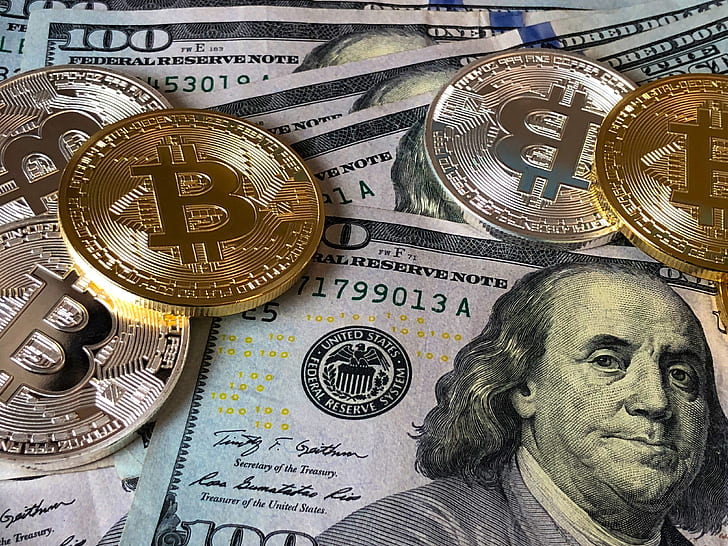
US could have a digital currency in 12-18 months.

US Dollar - Bitcoin

A Digital Currency is Being Openly Discussed

I think many people underestimate how quickly a digital currency could become a reality in the US (and possibly Canada). Some of the following stories are a few months old but taken together, they present a strong case that a digital currency could become a reality much more quickly than people are aware of.

The Prediction: A Digital Dollar (Pontentially) in 12-18 months

Sheila Bair, former chairman of the U.S. Federal Deposit Insurance Corp

Transcript:  (June 26, 2020)

I’ve been a big big advocate of digital currency central bank-backed or issued digital currency that actually could be distributed directly to households in times of stress

Give them cash you know don’t give them more debt and find what technology will allow you today to have a transmission mechanism that goes directly into households and obviously congress needs to authorize that there need to be very tight controls around it

but nonetheless in a situation like that we’ve seen how the government and the IRS on the fiscal side has struggled to get EIP funds to households those payments notwithstanding some of the problems and transmitting the payments have done a lot of good for the economy

and so but having some type of automatic stabilizer where cash could actually be distributed through digital wallets which are fairly easy to set up right now right into households that would be so much more efficient than pumping all this money into financial markets and seeing this giant chasm right between you know what’s going on the stock and bond markets and what’s going on with main street

Sheila, the digital currency idea is super interesting because there’s a real concern that the US is behind especially compared with other countries notably china are you concerned about that race to create a digital currency

Well I am I think you know we are privileged to have the world’s global reserve currency I don’t see that changing anytime soon but I do think one of the undercurrents of what china is doing at least especially in developed countries that have unstable currencies is to uh default to the renminbi you know as the currency of choice that they’re using their own countries through their central bank’s digital currency

So yeah I think that’s exactly what’s going on I think we need to wake up to it we shouldn’t be too complacent about our leadership position I think you know or the strength of our system the strength of our fed and its independence and its integrity I think will always give us the edge but we need to effectively use this technology domestically I think it’s insurgently needed but we should also think about how the dollar is used throughout the world.

The other thing nice about digital currency if it’s cryptocurrency if it’s traded on a distributed ledger you have a much better audit trail of transactions so from a law enforcement perspective kind of there’s an urban legend that somehow it’s it makes uh illicit transactions easier actually makes it harder because with the central bank issued or back digital currency you can actually trace the transactions where that that digital money is going through the distributed ledger so from a law enforcement perspective it also has huge advantages

But we do need to be very aware of what’s going on in other countries and the real risk of that is posed to us if we don’t effectively

leverage what you know what is is happening now I mean

I think between in 12 and 18 months we could probably have a system of digital currency if people really put their mind to it and again it needs to be authorized by congress uh but the fed I know has been looking at it for a while and I think we need to accelerate that.

[Read more…]

Investment Portfolios: Diversification Strategies


(filmed Feb 7, 2020)

Summary of Counter-correlation Strategies:

Chris Cole of Artimis Capital (the person being interviewed)  argues that most investors and pension funds are historically illiterate and use portfolios based on models of the last 40-years of market data, rather than longer-term market conditions going back to the 1920s.

Investment Eras:

  • Secular Decline (1929-1946)
  • Secular Rebirth (1947-1963)
  • Secular Stagnation (1964-1983)
  • Secular Boom (1984-2007)

Most people would be surprised to learn that most of the stock market growth of a 60/40 fund in the last 90 years occurred in the 1983-2007 era of Secular Boom.

90% of the returns of a 60-40 stock-bond portfolio came from the 22 years between ’84 and 2007.
Just 22 years drove 90% of the gains of that portfolio over 90 years.

The Limits of “Traditional” Portfolios:

Cole argues that approaches we think of as “traditional” have done well in the recent Secular Boom, but would not have done as well in other market environments:

  • 60/40 stock/bond fund: bonds don’t counterbalance a portfolio as well under zero interest rates.
  • “buy the dip”: would have gone bankrupt 3 times in the past 90 years

[Read more…]

What will Democrats have to pay Trump to leave?

Rod Blagojevich
Rod Blagojevich

How do Transactional People Think?

After Barack Obama was elected President, Illinois Governor Rod Blagojevich had the power to appoint Obama’s successor to the senate.

Being a “transactional” sort of guy, Governor Blagojevich, wanted to use what he had to maximize his own interests.

I got this thing and it’s  f****  “golden”:

FBI agents recorded  Blagojevich conversing with an adviser:

I’ve got this thing and it’s golden and I’m just not giving it up for nothing

Blagojevich was seeking:

  • a salary for himself and ($250,000-$300,000)
  • a position on a corporate board for his wife (~$150,000/year)
  • campaign funds, with cash upfront
  • a cabinet post or ambassadorship

Pardoned by Trump:

After he was impeached by the Illinois Senate, he was indicted and convicted in Federal Court and sentenced to 14 years in prison.

Blagojevich was unrepentant and protested his innocence, serving 8 of those 14 years, before being pardoned by President Trump.

What will Trump want in exchange for him leaving office?

Now it is still possible for Trump to fairly win the upcoming election.  But if he doesn’t win legitimately, will he go quietly?

I assume that Trump does not intend to give up the Presidency for “nothing” if he loses and that a lot of the choices he makes are about strengthening his hand and developing a narrative.

How much will Democrats be willing to pay, in money and otherwise, to have Trump leave office?  And what will be Trump’s ask?  Here’s my guess:

Mount Rushmore
Mount Rushmore

What will Trump ask?

  • Legal absolution: scuttle all the sealed indictments and future court cases against him.
  • Stop damaging disclosures: If not already public, silence unfriendly attention regarding tax returns, etc.
  • Financial Bailout/fleecing   His hotels and golf properties haven’t done well financially lately.   I don’t know the state of his financial need, but he seems to take pride in finding creative ways to fleece the taxpayer.  Expect financial demands.
  • Honor: recognition of his status as a great President.  Maybe a monument, naming rights to a building, etc.
  • Attention: Trump would likely want to host his own show or own his own network.  He needs to see a future for himself after the presidency.
  • Nepotism: Donald wants his family name to remain relevant so he may want some benefit, particularly for Ivanka, his favorite child.
  • Victimhood: Trump will need an excuse for why he didn’t get a second term both for himself and his supporters.  If defeated, like Blagojevich, he can not admit it.  The only way he will agree to relinquish power is under the condition that he can still insist that he was a victim and the election was rigged.

What will Trump Threaten?

The basic idea to keep in mind is that Trump is less concerned about the peaceful transfer of power than the Democrats are.  Trump has an affinity for chaos and that he will use that as leverage.

What do you think?

Everyone expects that Joe Biden will concede if he loses.

But if Trump loses but not in a big way, will he readily accept defeat?

If not, what will Trump ask and what will he threaten?


P.S.  Why is it that this sort of politician seems to have a thing for having a full head of hair?

Why Did Corporations “Waste their Capital”?

Hi Roger,
I’ve got a basic question about how the post-2008 “economic fragility” you mention in your May 13 briefing relates to the “wasted” leveraged buybacks Raoul Pal talks about in the May 15th briefing:
QUESTION:
Was the consumer too weak to support robust growth post-2008 and is that why corporations “wasted” their capital by buying back shares with borrowed money?
Background:
——————————————————————————————
 
(21:06) RAOUL PAL: So I’ve talked about this in the doom loop on Real Vision before as part of a whole thesis of mine, which is based around the maximum amounts of corporate debt in US histories now. That debt was driven by corporations basically wasting their own capital to buy back their shares, without putting it to more effective use and efficient and productive use. 
MY QUESTION:
What accounts for the use of buybacks rather than productive investments?
Why didn’t corporations use their capital for productive purposes?
(My suspicion is that consumers were too maxed out to afford substantially more consumption, so why invest in increased capacity?)
——————————————————————————————
Here’s what you said about two days earlier about “economic fragility”:
06:57
ROGER HIRST: … That’s going to be what’s happening, and so it becomes all about balance sheets. It’s corporate balance sheets, it’s household balance sheets and it’s government balance sheets. Have they been impaired?07:16
I think the key to all of this is that there was the underlying fragility of the global economy prior to this. This was not a strong economy, and I’m not just talking about the last year where we saw some numbers deteriorate. I’m talking about the world post-crisis 2008 where there’s never proper recovery. We had anemic growth. We had the illusion of health because the equity market in particular and in particular in the US, rose to these astonishing heights, but overall, a lot of people, median wages took a long time– real median wages in the US took a long time to get back to the 2007 levels. I think it was ’15, ’16– 2015 and ‘16.07:52
The man on the street, the woman on the street didn’t see a pickup in wages for a long time. A lot of people are living paycheck to paycheck, 46% of Americans have less than $1000 of cash in their savings account.
——————————————————————————————
MY QUESTION:
Did corporations think that their consumers were too maxed out to generate further growth in 2009 – 2020?
In other words, did they view their customer’s balance sheets and income growth potential so dimly post-2008 that they decided productive investments in additional capacity, etc were too risky and that it would be safer to take advantage of low-interest rates to use debt to buy back their own stock?
I understand interest rates were low and executives were looking to meet their bonus targets, but why did that entail so many share buybacks rather than productive investments?
 
SPELLING OUT THE IMPLICATIONS:
I figure the pros may already understand that this has taken place, but as a “citizen investor” I’d appreciate hearing this spelled out more explicitly.
If corporations were reluctant to invest before, what does that say going forward?