Our Latests Pretexts for “Regime Change” : Venezuela and Iran
Donald Trump is the “King of Pretexts” in a country where 10 of our wars since 1900 have been justified with pretexts. Recently in Venezuela, the pretexts of “Democracy Concern” and “narco-terrorism” have worn thin, as President Trump nakedly displayed his actual motive — a desire to control Venezuela’s oil.
Pivoting to Iran, where sanctions, a falling Iranian currency, and infiltration, have led to large public protests. Trump has a history of selectively repeating the now cynical-sounding “Democracy Concern,” along with Iraq-style fears of nuclear WMD as a pretext for the actual motive — Israel’s long-standing desire for “regime change” (and a breakup) of Iran.
The White House uses the narrative of Iranian nuclear WMD to justify further military action against Iran, deliberately conflating the concept of nuclear “Breakout”, which involves the production of sufficient nuclear fuel to make a bomb, with “Weaponization” — the building of a deliverable bomb. One can analogize this distinction to the difference between having enough gasoline to fuel a roadtrip, to building the car that will carry out that trip. On June 17, Trump was asked about his assessment of Director of National Intelligence Tulsi Gabbard’s report that Iran was not building a nuclear weapon. Trump replied: I don’t care what she said. I think they were very close to having one
disavowing both his DNI and the Intelligence Committee whose view she represents, and favoring Israeli “Intelligence” over his own US Intelligence Community’s assessment.
A History of Phony Justifications
They took the babies out of incubators, took the incubators and left the children to die on the cold floor.
Since 1900, U.S. leaders have misled the public into conflicts at least ten times. From the munitions hidden on the RMS Lusitania in 1915 to the fabricated “incubator babies” testimony that swayed the 1991 Gulf War vote, and the non-existent WMDs in 2003, propaganda has consistently been used to sell unpopular or unsuccessful wars. (Read longer article)
Currently, hawks in the U.S. and Israel are pushing a narrative that would achieve a “sequel” to the Iraq WMD war, completing the aspirations of neoconservatives’ to overthrow seven mid-east countries, albeit not in the originally projected 5-year timeframe. While the public is told the goal in Iran is “denuclearization” or “democracy”, the actual objective is and has been Iranian regime change.
The Nuclear Claim vs. Reality
Following the 12-Day War in June 2025’s “Operation Midnight Hammer,” White House Secretary Karoline Leavitt claimed that Iran would only take a couple of weeks to complete the production of that weapon
However, the fact that this was actually an Israeli assessment of the Iranian nuclear program, which the American Intelligence Community disagreed with, wasn’t widely known. U.S. Intelligence (the IC) maintained that while “Breakout” (accumulating enough fuel) could take weeks, “Weaponization” (engineering a deliverable warhead) would take six months to a year. Moreover the American Intelligence Community has consistently maintained that Iran is not building a nuclear weapon and Supreme Leader Khamenei has not authorized the nuclear weapons program that he suspended in 2003.
(I’ve developed a citation app that enables readers to inspect citations to view quote context. Feel free to dig into the cited quotes!)
CIA Director William Burns and DNI Tulsi Gabbard both testified in early 2025 that the CIA doesn’t see any evidence that Iran’s Supreme Leader [Ali Khamenei] has made a decision to move to weaponize,
and has not lifted the prohibition (fatwa) on nuclear weapons which would be needed before nuclear weaponization would be allowed to proceed. Despite the dissenting American assessment, which has the benefit of not being biased by the same conflicts of interests as the Israeli assessment, the media often fails to differentiate between Israeli claims and actual U.S. intelligence, creating a manipulative narrative that ignores the American IC’s dissent.
The Goal of Regime Change
Evidence from the 12-Day War confirms that the June mission went beyond bombing nuclear sites at Fordow and Natanz. Israel conducted cyberattacks to hijack Iranian State TV, replacing broadcasts with protest imagery designed to spark a revolution. Israeli think tanks, such as the INSS, have since admitted that regime change was the ultimate goal:
it is clear that some of Israel’s actions, especially during the second week of the war, were intended to undermine the regime’s foundations and encourage the Iranian public to take to the streets and resume their popular protest movement. Moreover, these actions presumably would have continued and perhaps even intensified had the war not ended in a ceasefire after 12 days
Israeli (2), Kuwaiti, and French sources reported that the satellite feed for Iranian state-run television was disrupted on ~ June 19 and replaced by an alternate video calling for street protests against the Iranian government. On State TV the satellite feed was replaced with video showing women cutting their hair, a symbolic Iranian practice performed in times of protest or mourning. (video)
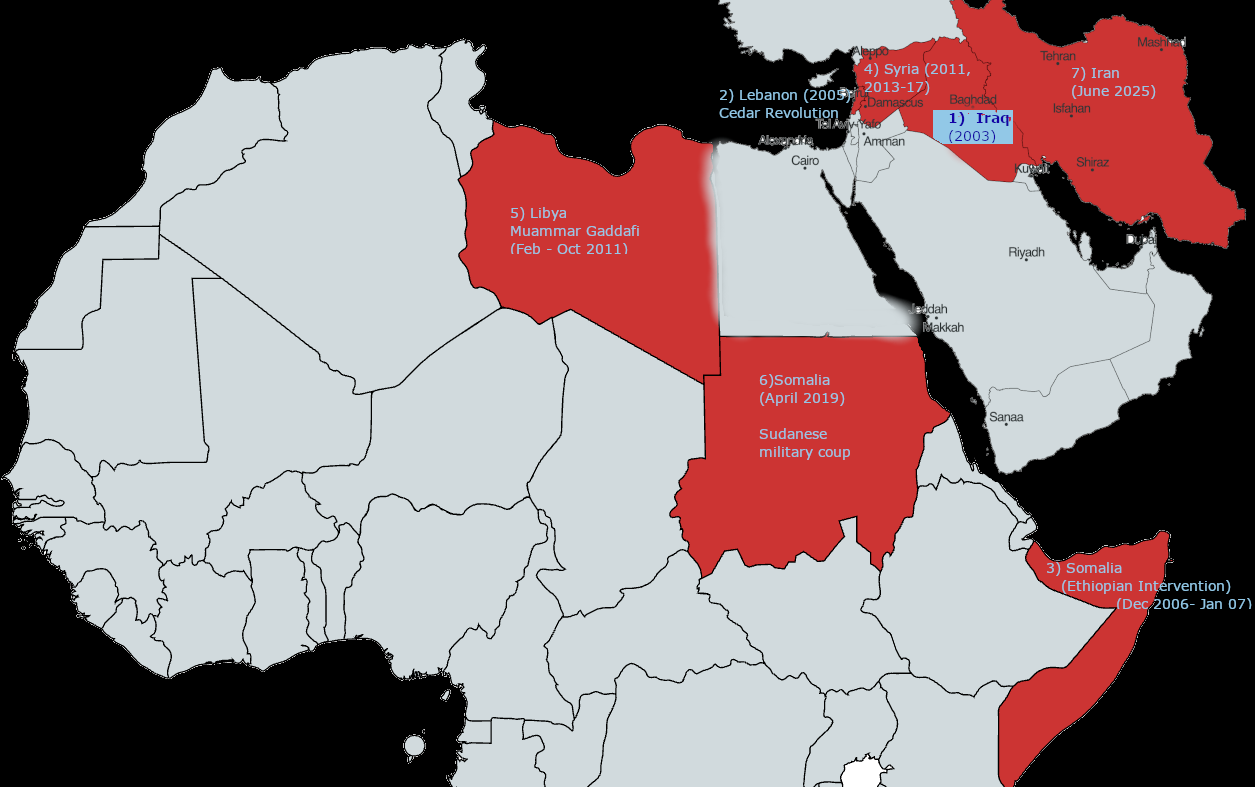
This regime-change strategy is consistent with the 2007 revelation by General Wesley Clark that he was shown a memo that describes how we’re going to take out seven countries in 5 years, starting with Iraq and then Syria, Lebanon, Libya, Somalia, Sudan, and finishing off Iran.
7 Countries in 5 years: intervention:
- Iraq (March 2003, regime change)
- Syria (Aug 18, 2011) (Timber Sycamore 2013-2017)
- Lebanon (Cedar Revolution 2005)
- Libya (Feb – Oct 2011)
- Somalia (Ethiopian intervention Dec 2006 – Jan 2007)
- Sudan (April 2019 Sudanese military coup)
- Iran (2025 anti-nuclear strike & regime change attempt)
Iranian Missile Deterrence?
In theory, the risk of a regional or world war should be precluded by Iran’s large conventional missile deterrent, which Iran demonstrated is capable of breaching Israel’s Iron Dome. Perhaps Israel has the ability to disable Iran’s thousands of missiles electronically, or perhaps Israel believes it has a way to overthrow the Iranian government without provoking Iranian retaliation using missiles.
If full war breaks out with Iran, it has the potential to lead to a decade-long conflict far more catastrophic than Iraq. Potential consequences include a blockade of the Strait of Hormuz, leading to $7/gallon gasoline, and even the “Samson Option“—a nuclear murder-suicide threatened by Israel in the event they would be defeated.
Let us hope that operational success in Venezuela has not emboldened a president who campaigned on “peace” to risk regional or world war to satisfy a “regime change” that his Presidential campaign promised his voters he had forsworn.
by Tim Langeman | Homepage | Substack | YouTube